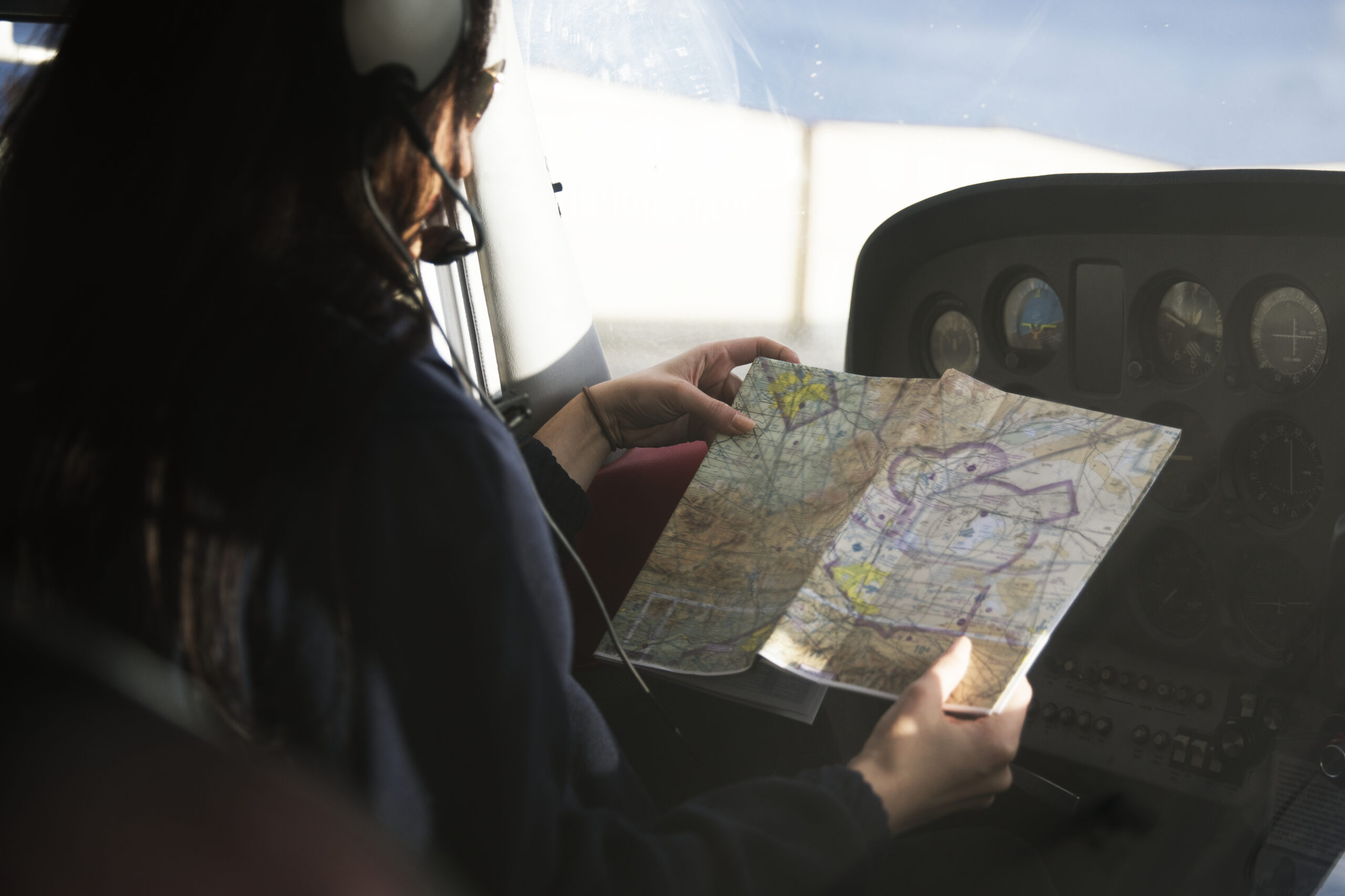
Imagine this: It’s 1985. Your flight bag isn’t a sleek sleeve for an iPad, it’s a heavy canvas satchel stuffed with paper sectionals, a metal E6B flight computer, and a bulky operations manual. Your “GPS” is a map, a clock, and a keen eye on the railroad tracks below. This was the daily reality for student pilots navigating an air traffic system still recovering from the 1981 PATCO strike.
In this article, we’ll explore what it really took to earn your wings back then: the equipment you carried, the skills you mastered, and the challenges you faced before iPads and GPS changed everything. Then, we’ll tackle the debate that still divides pilots today: has technology made us safer, or just lazier?
Think you could have passed training in 1985? Scroll down to find out.
Analog vs. Digital: The Tools That Shaped Two Generations of Pilots
The pilot training equipment of 1985 was analog, tactile, and required the pilot to be the central processing unit.
The 1985 Flight Bag: The Weight of Knowledge
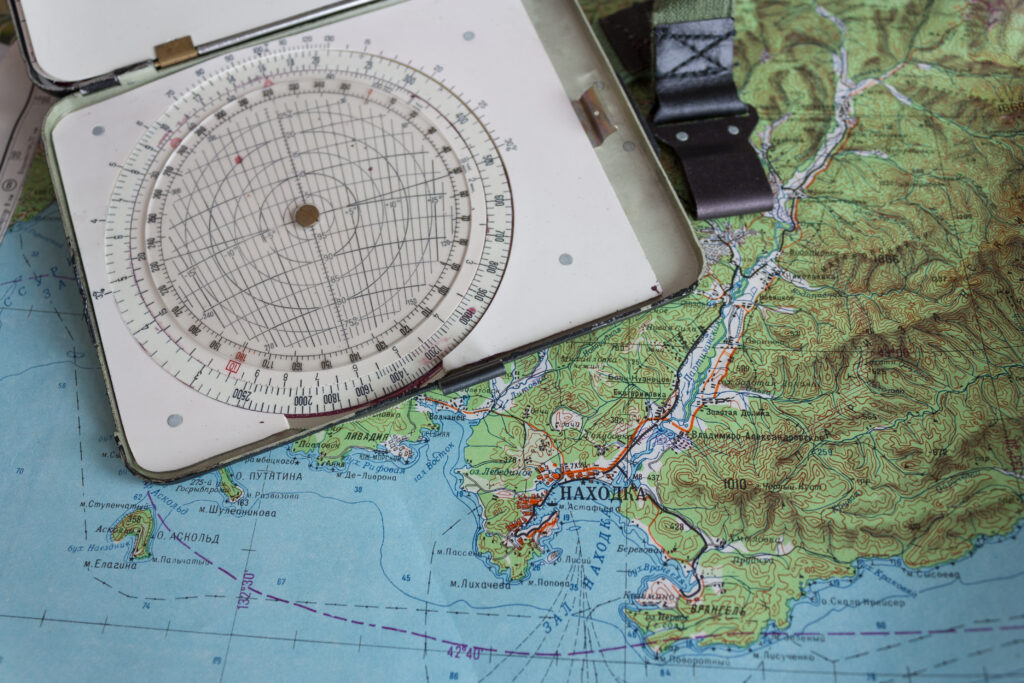
- Navigation: Paper sectional charts, a plotter, and an E6B flight computer—a circular slide rule for calculating speed, time, fuel, and wind correction. It wasn’t an app, it was a skill you had to perfect.
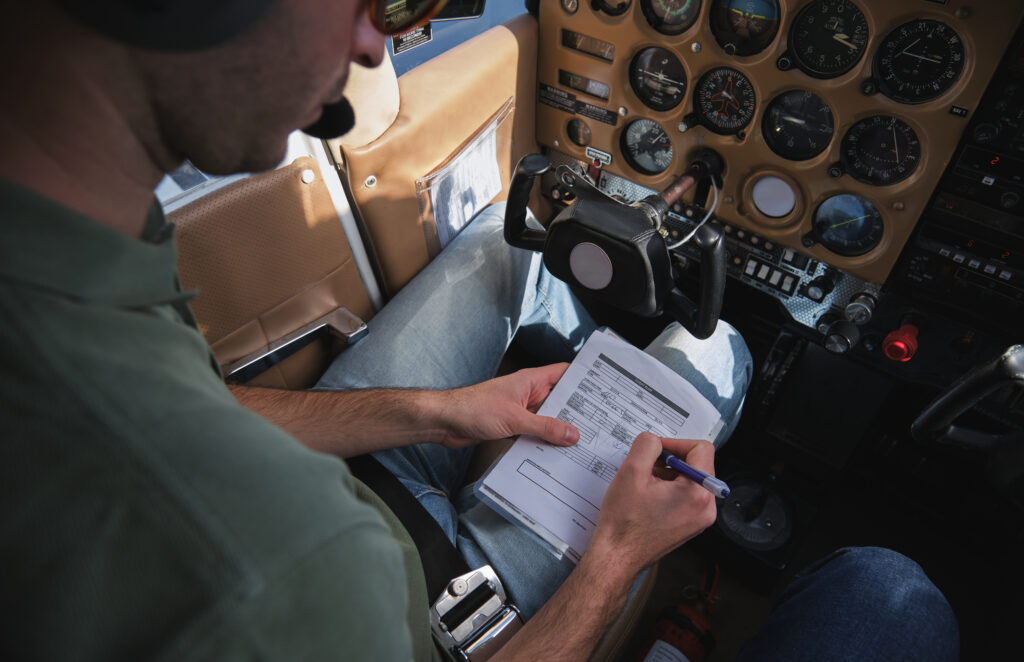
- Flight Planning: A paper flight log, an Airport/Facility Directory for frequencies, and a thick aircraft Pilot’s Operating Handbook.
- Cockpit: A basic headset was a luxury, many used foam earplugs. Your knee board held folding paper approach plates.
- Radio Navigation: You tracked VORs and NDBs by tuning and interpreting sometimes-fickle needles across the dial.
The Modern Flight Bag: The iPad Revolution
- Navigation: A single iPad with ForeFlight replaces every paper item above: GPS moving map, geo-referenced plates, and data. Modern pilot training apps have made information instant.
- Situational Awareness: Add a Stratus receiver, and you get real-time traffic, weather, and terrain.
Simulation: As one pilot noted, “PC simulators now are FANTASTIC! You can learn the whole cockpit setup… at home before your first flight.” Today, many students use pilot training flight simulator platforms to get ahead before ever stepping into a cockpit. That preparation was impossible in 1985.
The “Self-Improver” Route: The Skills You Had to Master
Unlike today’s structured cadet programs with pilot training sponsorship, the 1980s path was often the self-funding “self-improver” route. It forged a unique skillset.
- Dead Reckoning & Pilotage: No iPad backup. You matched landmarks to a paper map, and confirmed your position. That was navigation.
- Mental Math: Headings, groundspeeds, fuel burns—you calculated constantly. Getting a PPL meant two stages: a “Restricted PPL” for local flying, then a navigation flight test for an “Unrestricted PPL.” Navigation was an examinable skill, not an app feature.
- Radio Navigation as “Dark Art”: Tracking an NDB meant wrestling with signals that bent over coastlines and during storms. It demanded intuitive feel.
Information Gathering: Weather briefings meant phoning Flight Service for a verbal description. You built a mental weather model without ever seeing a radar image.
The Curriculum: Hours, Exams, and Licenses
The pilot training syllabus of 1985 looked nothing like today’s.
- Hour Building: The path to a Commercial Pilot License (CPL) was an endurance test. In Australia, a CPL required 150-175 hours. In the UK, you could get a Basic Commercial (BCPL) at 150 hours—but then needed 700 hours of working (instructing, towing gliders) to upgrade to a full CPL.
- The Exams: No multiple-choice guesswork. You couldn’t retake a section the next day.Passing meant proving you understood pilot training qualification standards inside out.
The Instrument Rating: The IR was often split into classes (Class 1 vs. Class 3 for GA pilots) with different limitations—a more graduated approach than today’s binary “IR or not.”
The Great Debate: Has Technology Made Us Safer, or Just Lazier?
The 1980s gave us both the problem and the solution.
The Case for “Safer”
- The Birth of CRM: After United 173, the industry realized technical proficiency wasn’t enough. CRM taught pilots to communicate as a team, flattening the deadly “power gradient.” It’s now the bedrock of every pilot training program and crm pilot training worldwide.
- Automation & Awareness: The 1980s brought EFIS and GPWS. Today, that means moving maps, terrain alerts, and traffic displays. GPS made precision navigation universal.
- Data-Driven Training: Programs like AQP use data to train pilots to proficiency—far from one-size-fits-all maneuvers. This shapes today’s pilot training curriculum.
The Case for “Lazier”
- The “Magenta Line” Syndrome: When students follow an iPad, pilotage atrophies. If screens go dark, can they fall back on a map? Every pilot training class should ask this.
- The Death of Mental Math: The E6B is a relic. Apps are faster, but manual calculation built deeper understanding. A 1980s pilot felt the wind correction, today’s pilot just reads the number.
- Over-Reliance: Simulators are an advantage, but they create device dependence.
Conclusion
Passing pilot training in 1985 wasn’t harder—just fundamentally different. It demanded manual calculation, spatial reasoning, and self-reliance that’s hard to replicate in an app-driven world. That pilot navigated with a map and trusted their own scan above all else.
The best pilot respects both eras. The 1985 pilot would marvel at a glass cockpit, the 2026 pilot should respect the skill it took to fly cross-country with just a chart and a clock. The challenge is to embrace new technology without losing the foundational skills that made those achievements possible.
What do you think? If you trained in the 80s, what skill do you miss most?